Email: rachelkramerbussel at gmail.com


Lusty Lady

BLOG OF RACHEL KRAMER BUSSEL
Watch my first and favorite book trailer for Spanked: Red-Cheeked Erotica. Get Spanked in print and ebook

Wednesday, April 12, 2017

New articles on breakup sex and open marriage

I'm a little behind on blogging because I've dipped my toes back into freelance writing, with an article on breakup sex in The Washington Post's Solo-ish section and an as told to interview profiling a week in the life of a woman in an open marriage for Redbook. Regarding the latter, I was thrilled that they asked me to cover polyamory in a total non-judgmental way that highlights the experience of the polyamorous person. These assignments were also great because when I have a lot of time I tend to agonize and overthink, but with only a few days and a little over a week to complete them, I had to hustle and get busy. In my forties, I'm finally learning the ways I work best and trying to use them to my advantage and I'm very grateful to these two editors for being great to work with and giving me these opportunities.

It's felt wonderful to get back to writing; I really couldn't muster any ideas or focus right after the election, thinking everything I considered was pointless, but now I realize that life goes on and that I have to continue to learn and grow and push myself so I'm working on new pitches and pieces that I will share once they are finalized.

I've got more articles coming up, so stay tuned to my Twitter and Facebook pages, and if you like free erotica books, subscribe to my newsletter on the left side of my blog or on my website. I meant to send April's last week but didn't get to it so it'll be going out soon with a giveaway of my new anal sex erotica audiobook.

Labels: , , , , ,

Thursday, March 23, 2017

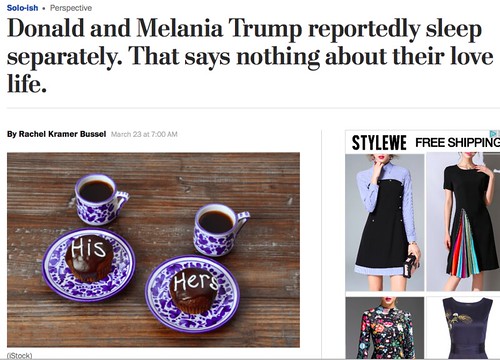
My Washington Post Solo-ish essay on sleeping in separate bedrooms

I haven't written an essay since November, so it feels wonderful to be back at the Solo-ish section of The Washington Post today with this essay on why I prefer sleeping in separate bedrooms, and how that's not a sign of how a relationship is doing, whether we're talking about the President and First Lady or anyone else.

soloishseparatebedrooms

Labels: , , , , , , ,

Thursday, September 22, 2016

Washington Post Solo-ish essay on baby fever and why I want to be a mom

I wrote about the subject I think about every day, and an incident recently that made me think about it in a new way: wanting to be a mom, and why being childless feels worse than being single ever did, for the wonderful Solo-ish section at The Washington Post. If you're not a regular reader, I recommend it; I learn a lot from the pieces I read there, which are always insightful (I don't mean that as a brag, humble or otherwise; I'm referring to the other writers, like Nicole Hardy on being a "female bachelor" in her forties and travel as her suitor and Laura Barcella on being a "crazy cat lady" and all the bylines you see there).

Here's a snippet of my piece:
In the minute or so that I helped her to those gulps of water, which still managed to spill down her dress despite my carefulness, I felt an overwhelming urge to pull her close and give her a hug. Her mix of delicateness and strength, her ability to communicate nonverbally, her gorgeous eyes staring back at me as if we weren’t strangers, all completely sucked me in.

If I could feel so much for a child I didn’t even know, who belonged to someone else, how much love would I have for a child I named and fed and cared for every day? That question haunts me.
Read the whole essay

Labels: , , , , , , , ,

Friday, September 02, 2016

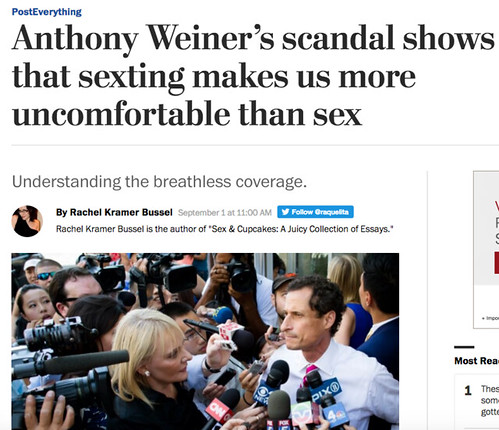
My Washington Post essay on Anthony Weiner and the allure of sexting

It's been a busy writing week, to say the least. I share all my writings on Twitter and my Facebook page if you want to keep up with the latest. By the end of today, I'll have filed seven pieces this week so it's hard even for me to keep track of them all! When something like the Anthony Weiner sexting scandal happens, a writer like me who's covered the topic in the past is often inundated with people wanting your opinion. Sometimes that's a good thing, because it forces you to keep up with the latest news and write quickly, without second guessing. Sometimes it feels daunting because I actually prefer to pause and (over)think and sometimes even agonize over my writing, but these days, with two part time jobs that equal full time hours, I don't have the time for that.

My first piece on was for Salon about the Weiner story and how he contradicted his past remorse.

Then The Washington Post asked me to explore why sexting draws so much attention for there PostEverything section, so I did. This was my second piece for that section (following last year's essay on hoarding) and rather than explore too much of the details of Weiner himself, I focused on the act of sexting and what makes it special.

washington-post-anthony-weiner-sexting-rachel-kramer-bussel

If you want to hear even more from me on the topic, tune in to Radio New Zealand for Saturday Morning with Kim Hill, which airs at 6:12 p.m. EST tonight (Friday, September 2, for those on the East Coast of the U.S.).

Labels: , , , , , , , , , ,

Tuesday, December 29, 2015

My proudest accomplishment of 2015

I achieved a lot in 2015, things I truly never though I could or would, and I will be recapping the highlights of this year's writing and editing on my blog in the next two days. But the accomplishment I'm most proud of is about my actions behind the scenes. I'd been encouraging my grandfather to write an op-ed about what's needed to help veterans, specifically those suffering from PTSD, an area he's a double expert in, based on his own experience as a POW in WWII (which you can read about in his memoir) and his work helping veterans file claims for benefits owed to them. Every time I would read about a similar issue in the news, I would let him know and gently nudge him to write something, but as I know well, nobody can ever "make" you write anything. That's not how our minds or creativity or impulses work.

So when I sold my hoarding essay to The Washington Post's Post Everything section, I realized the section might be a good fit for what I envisioned from my grandfather. I'd of course been reading Post Everything to get a feel for what they were looking for, and the more I read, the more that connection leapt out at me. I did something that gave me butterflies in my stomach, because it bordered on, and perhaps was, rude and unprofessional, but felt worth the risk: I asked my editor if she'd be open to him sending her a pitch. Specifically, I wrote:
Also, can I pass your email address on to my grandfather? I know that sounds very "I have a friend who wants to be a writer" but I promise it's not. He's 91, wrote a memoir about being a POW in WWII and now helps recent veterans file PTSD related claims so has a fascinating, and sometimes heartbreaking, perspective. Yes, I'm biased, but I do genuinely think he has a unique take on it. I've been encouraging him to write an essay or op ed about the types of issues he sees, including addiction and alcoholism, homelessness, joblessness and how the VA and government could better serve these vets. Just didn't want you to think I'm passing around your info indiscriminately.
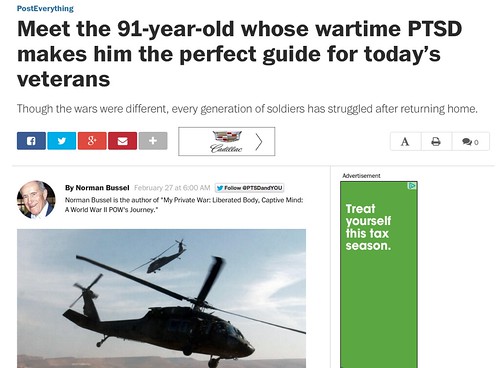
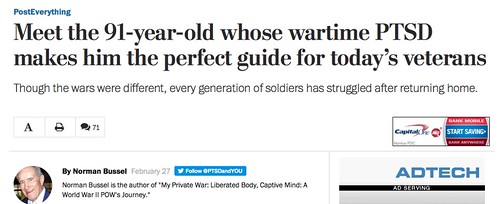
I got an immediate, enthusiastic response, followed by another one, which I passed on to him, and he took it from there, and on February 27th, a few weeks after my essay was published, his essay "Meet the 91-year-old whose wartime PTSD makes him the perfect guide for today’s veterans" was published.
grandpaessay

I really can't express how thrilled I was, because I believe his story is unique and relevant to what's happening in the world today, two qualities I look for when I teach writing classes and whenever I say to someone "You should write an essay about that." It's an oft-repeated refrain from me, but again, I get the sense that many who have brilliant essays lurking inside them are hesitant to unearth them, which is understandable. It can be emotionally challenging, heart wrenching work, especially work done on spec ("on speculation," meaning without guarantee of publication or payment). It can seem overwhelming to cram what feels like your life story into 700 or 800 or 1,000 or 1,200 words, or even into 2,000 or 3,000 words. But what about this thing that happened, and that thing? Aren't they important? It can feel treacherous to be pushed to delve deeper into certain areas, or leave others out. And that's all before a piece is even published; once it is, you're subject to the whims of anyone who wants to comment in any way at all, good, bad, indifferent, rude, ill informed, etc.

But I'm not here to detail the umpteen reasons why people might not want to write about their lives; I know them intimately, and likely, you do too. I'm here to tell you that I felt so overjoyed that my instincts had been right, that the response my grandfather received was incredibly positive, warm and welcoming, precisely because, in my opinion, he did not shy away from his own darkest times, his own suffering, but he also showed how he uses those experiences to help others. I was happy because it brought his perspective to a while new audience, including Captain Sully Sullenberger, especially those who'd also been affected by WWII specifically.

I wanted to write this post to highlight his essay in case you missed it when it originally ran, and remind myself of what I want to do more of going forward: encourage other writers, which I've done in my calls for submissions, in my classes, in my private online group for my writing student alumni, and will be doing more of in the new year with a newsletter focused on writing advice and tips, plus with coaching writers and polishing their words before they submit them (stay tuned!). If you take anything away from this post, it's that if you have a story to tell, I strongly, strongly urge you to tell it, if you can get over all the mental and emotional and other hurdles that takes, not only because there are people who need to hear it but also, and most importantly, because you will be changed for the telling.

Labels: , , ,

Thursday, October 22, 2015

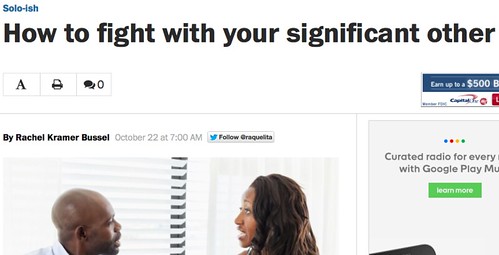
Washington Post article on how to fight with your significant other

As you probably know, I'll take almost any opportunity to use my personal life as fodder for my writing. Which may sound bad, but is both honest and, I hope, I learn things as I write that can improve my relationship. That's certainly the case with my latest Washington Post Solo-ish article on "How to fight with your significant other." Thanks to Sherry Amateinstein, Mark Michaels and Patricia Johnson for sharing their expertise. (In case you missed it, my first piece for them was on why I don't want to get married.)

wapofights

Labels: , , , , , , , , , ,

Wednesday, October 07, 2015

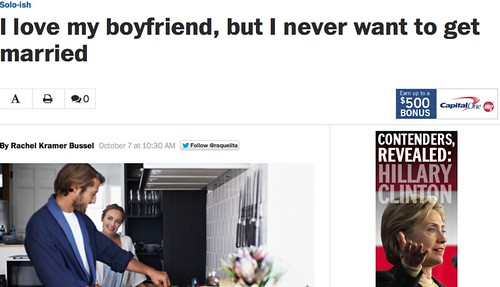
My Washington Post essay on why I don't want to get married

My essay "I love my boyfriend, but I never want to get married" is up today at The Washington Post's Solo-ish section. The title pretty much tells you what it's about. Whether you agree with me or not, I hope you'll check it out. Yes, I'm pushing myself to pitch new markets and kick my own ass in light of the end of my weekly column, and so far, it's working.

waponotmarried

Labels: , , , , , , , , , , , ,

Saturday, February 28, 2015

Read my 91-year-old grandfather's Washington Post essay about veterans and PTSD

I could not be prouder that my 91-year-old ex-POW grandfather published his essay "Meet the 91-year-old whose wartime PTSD makes him the perfect guide for today’s veterans" yesterday in the Washington Post. Please read it and, if you're so inclined, share it. It's brave and honest and offers what I've long told him is a unique perspective as someone with PTSD from WWII who is using his history to help modern veterans.

normanwapofeb27

Labels: , , ,

Saturday, February 07, 2015

A week in the life of a full-time writer

Since getting laid off in the fall of 2011 from my full-time magazine editing job, I've called myself a full-time writer and editor. Technically, that has been true, and in the last two years I've added a lot more teaching and consulting to that equation. But this past week, I've realized how not quite accurate that was, because that definition of "full-time" had a lot of give and take, a lot more lee-way. You don't have that when you're on tap to file, file, file. Maybe that's obvious to anyone who's had a newspaper job or a more strenuous freelance career. The truth is, I got lazy. My books were doing okay, so I was able to coast. Then, last year, that abruptly ended and I've got zero tricks left to try to get my books back into some semblance of popularity. I still have hope, which is why I do things like give away free books to Thunderclap supporters. It's more a matter of my time; I have to use it as wisely as possible, and book promotion has fallen by the wayside in favor of earning a living. Ultimately, the lesson that I may love my books, but the world may not, was a good thing because it showed me I cannot rely on something so precarious if I want to support myself and, hopefully, a child. That would be utterly foolish and I don't want to make the same mistake twice.

So when I got offered new work out of the blue, of course I took it (I don't say yes to everything, but I do my best to pursue writing opportunities that will help my bank account and my career). Hence, this week, I've gotten up before six every day and been going-going-going what feels like the entire day, with a little time with my boyfriend, and then back at it. It's an honor to have editors believe in my work enough to ask me to not only write for them, but trust that my story ideas are worthy. Writing for Salon, in this case, is something I dreamed of for a decade before it finally happened.

So I am in no way complaining, just noting that this week was a handful. It's meant constantly being on my laptop so that I can reply to the latest round of edits on an essay, scouring the internet for something noteworthy to cover, interviewing authors, planning upcoming sex columns, promoting the ones that went up. It's been wonderful, but definitely not a pace I could keep up forever, even though I definitely need the money. As I try to be a responsible adult in middle age, for the first time in my life, I'm trying to truly live by the Serenity Prayer and abandon the aspects of my career I have no control over and focus on the ones I do. This is also part of flexibility: recognizing what's not working and choosing to move into new arenas, rather than literally doing the same thing over and over again. It's a challenge, and one I don't always live up to, but I'm trying, and I'm writing this post mostly to highlight, for me, that I can do it, even when it seems hard or impossible. That even though being this kind of full-time around-the-clock writer can feel daunting, I have work I can truly be proud of to show for it and it can be about topics as varied as I am. And who knows? Maybe someday I won't be doing all of this from home, and I'll get to work at a cool office where the fast pace will be fun and I'll have colleagues to bounce ideas off of. Part of me would absolutely love that; I miss co-workers, and think I'd enjoy the fast pace of that kind of writing or editing job. I don't mind fast-paced, but I think the other side of loving what you do is being able to have a little time away from it too, hopefully.

While writing this post, I took a Facebook break and found this piece in The New York Times on "Why You Hate Work" by Tony Schwartz and Christine Porath. From that article: "The more hours people work beyond 40 — and the more continuously they work — the worse they feel, and the less engaged they become." I get that, intensely. I want to make it clear, I don't hate my work, I just don't want to get burned out and then give up and then not hold up my share of my household duties. That is my biggest fear, which is different than when I lived alone. Then, I was the only one to answer to. Now, there's an added layer of shame when I have to borrow money for rent because I didn't save enough, or a check was later than expected, or whatever the issue du jour.

I'm wrapping up next week's articles and columns and then putting on a different hat: LitReactor writing teacher. I can't wait to dive in with my 16 students and see what they come up with, and I am also hoping to book upcoming online classes as well.

I didn't write all of these this week, but this is what I've published from Saturday to Friday. Thank you for believing in me, editors, and thank you for reading. Yes, there's lots more next week. I look forward to more, just at a slightly less crazy pace. On the off chance you're an editor reading this and you like my writing, please don't let my pre-coffee 8:35 on a Saturday morning tone discourage you; I'm available for work, starting now. Okay, after my coffee.

"Do condoms kill the mood of a book? Erotica authors don't agree on safe sex demands" for Salon

"Why Marriages Cannot Be End Goals (And The Ways We Still Convince Women They Are)" for Thought Catalog

"Old magazines, stuffed animals, and sex toys: How hoarding shaped my relationship " for Washington Post Post Everything

"Fresh Meat: Fry Another Day by J.J. Cook" for Criminal Element

"Sex shop crimes: How vandals, creeps and violence threaten our neighborhood vibrator peddlers" for Salon

"The Huffington Post's 'good news' experiment is bad news for Facebook" for The Daily Dot

"Meet a sexier, smarter Dom than Christian Grey" for Philadelphia City Paper

"Christian sex activists warn against the “dangers of mommy porn” and “50 Shades of Grey”" for Salon

"The anti-Pick Up Artist’s Guide: A new graphic novel teaches teen boys how to form healthy hook-ups" for Salon

Labels: , , , , , , ,

Thursday, February 05, 2015

Why being flexible is one of the most important things a writer can do

I fully believe flexibility is one of the most important traits a writer of fiction or nonfiction can have. Yes, you love your words, and yes, you have your goals and ambitions for them, but unless you run your own magazine or website or publishing house, there will be times you have to compromise or, as is often the case for me, not so much compromise but let an editor guide you into making your piece better and/or more in line with what the publication wants.

This week, I got my first byline in The Washington Post with my essay "Old magazines, stuffed animals, and sex toys: How hoarding shaped my relationship" in their Post Everything section, which was Post Everything's most read story on Tuesday and Wednesday. Here's the thing: my original draft looked nothing like what got published. Neither did my second. The title and focus were on completely different aspects of hoarding, and while my editor was interested in the topic, those earlier versions didn't quite work for what they were going for.

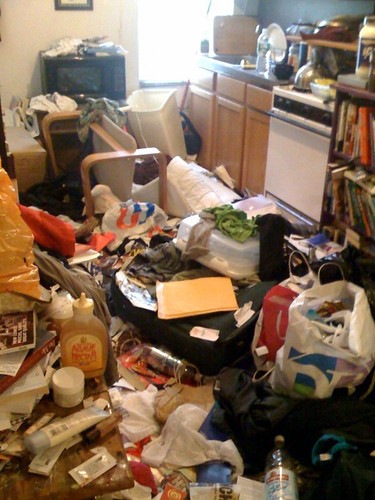
So I went back to the drawing board. I offered a few possibilities for what angle might work and when we decided on relationships I went for it. My first working title was "How My Hoarding Is Threatening My Relationship" followed by "Do I Love My Stuff More Than My Boyfriend?" Then that got finessed into what you see above. If I hadn't been flexible about that, or had thrown a fit over the title that ultimately went with the piece, which I saw for the first time when it went live Tuesday morning, I would have been persona non grata there. But as a writer, I want my work to be read by as many people as possible, not because I'll get paid more, but because that's the whole reason I'm putting such personal information out there in the first place. If this version, with this title, along with the photo of my hoarding that was requested, will make the essay a better fit for their audience, I'm all for it.

wapophoto

Guess what? It worked. My essay was the most read piece on Post Everything on both Tuesday and Wednesday. Yes, that matters to my editor and, on a personal level, to me. It means I did my job well (I'm not saying if a piece performs poorly traffic wise, or, as I certainly know well, a book doesn't sell, that the author/editor didn't do their job well though, because there are so many factors going into it), it means the combination of words and photo and placement and social media and whatever else makes someone want to read about the life of a hoarder succeeded. And this may not be true for everyone, but when I have one writing win, it makes me excited to work on the next one (sadly, the opposite happens too, and my poor boyfriend has to live with my hoarding and my moping when I get writing rejections).

For the record, I pitched a different piece about hoarding to another publication I'd love to break into, and it got rejected, but kindly so. Since there seemed to be interest in the topic, and it's one I know not tons of people are writing about from a first-person perspective, I tried Post Everything. I was flexible about who I wrote for, what I wrote, what images went with it and how the piece was positioned, because I see this one small essay as part of my larger career as a writer. I especially love when I get to write about topics that are not sex, because I do so much of that already. I love writing about sex, and have been honored recently by some of the topics I've gotten to cover and the things people have shared with me, especially ones that I feel can make a difference, such as the sex toy store crime article, but I also rebel hard against being stereotyped as a single-issue writer. That is not my goal and it's freeing and exciting to be recognized in another arena, even if "sex toys" are in the title. So thank you for reading this piece, and I hope this inspires you to dust off a rejected piece and get it out the door.

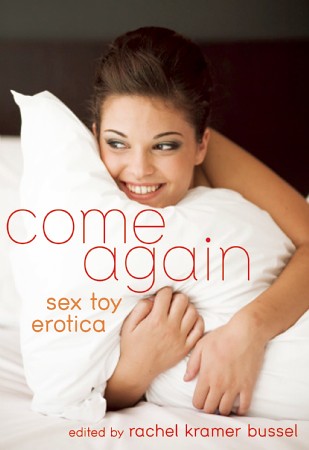
Not coincidentally, this week I finally sent out rejection emails for my spring Cleis Press anthology Come Again: Sex Toy Erotica. I procrastinated on it because I despise it, and am always considering quitting erotica anthology editing because it is not fun and kind of makes me feel like an awful person when I have to do it, even though the numbers will tell you that 100+ submissions of at least 1,500 words each cannot fit into a 65,000 word book. Because this book took me a longer time than usual to finalize, I found that many authors had already sold their rejected pieces to other publications. This made me feel so much better about the difficult task I was faced with, and reinforced my intuition that a rejection is just one publication's reaction (which, as an editor, I can tell you happens for so many reasons beyond an author's control), and that another may be ready to snap up your story/essay/article/etc. Here's the cover of Come Again, which I'm 99% sure will be on sale at CatalystCon at the end of March and in stores close to then too - stay tuned for readings and events, and click on the cover or title above for my introduction and the table of contents!

comeagaincoversmall

Labels: , , , , ,

Tuesday, February 03, 2015

My Washington Post essay on hoarding and love

I have a new essay up at The Washington Post's Post Everything section called "Old magazines, stuffed animals and sex toys: How hoarding shaped my relationship." I wrote the subtitle, they wrote the title, and I also included the photo below of my old Brooklyn apartment. Here's the thing: when you write personal essays, you need to go all in, in my opinion. Not just for your editor's sake, but for yours. I've struggled with writing about some of the worst of my hoarding, because I'd like to think I'm "past it," but as you'll see in the essay, I'm not. Also, this is one of my biggest bylines, so if you like the essay (or feel anything about it, or just want to support my writing career), I'd love it if you'd share it, either publicly or privately with someone who may get something out of it. Yes, I'm a hoarder, but I firmly believe hoarding doesn't only affect "hoarders," but all of us. It's about what we do with our stuff and how we value it, and even compulsively neat people are impacted by fear of becoming hoarders. Also, it's about love, and I am in love, big time.

wapophoto

Labels: , , , , , , , , , ,

Sunday, February 06, 2011

Carrie Brownstein on Portlandia

From the Washington Post:

"In a lot of communities, whether it's Williamsburg or Austin or Madison [Wis.] . . . you have these people that are very stifled and conflicted by their own sense of altruism," Brownstein says. "I think that's the underlying theme of the show. . . . A lot of comedies are based on people being bad. Ours is based on people trying to be good."

And while music remains her primary love, Brownstein says the show gives her an outlet that rock-and-roll can't provide.

"As much as I admire bands that can get to a place of sheer weirdness, that's just not the kind of music I make," she says. "I think 'Portlandia' definitely occupies a sphere of silliness and outlandishness that I would not be comfortable going with in music."

Labels: , , , , , ,